Table of Contents
Introduction: Tennis History, Redefined in Melbourne
Carlos Alcaraz’s victory at the Australian Open 2026 has not just redefined what’s possible in men’s tennis—it’s rewritten the record books. At barely 22 years old, the Spanish prodigy clinched the first Grand Slam of the season in commanding style, becoming the youngest Grand Slam king in the Open Era. His triumph comes after a series of meteoric rises, injuries, and epic battles with legends and new contenders alike.
In an era characterized by athletic parity and relentless competition, Alcaraz’s Aussie triumph signals both a changing of the guard and the dawn of a new tennis dynasty. Fans, pundits, and sponsors are all asking: What makes Alcaraz unstoppable, and what can the tennis world learn from his success? In this comprehensive analysis, we explore how Carlos Alcaraz conquered Melbourne, the strategy behind his play, and what this historic feat means for tennis’s future.
The Road to Melbourne: Alcaraz’s Journey to Grand Slam Supremacy
How Did Carlos Alcaraz Prepare for the 2026 Australian Open?
Carlos Alcaraz’s road to the Australian Open 2026 title was anything but effortless. Preparation, adaptation, and strategic innovation played pivotal roles:
- Rigorous Off-Season Training: Alcaraz worked closely with his coach, Juan Carlos Ferrero, to strengthen his endurance and footwork. This focus on fitness gave him a physical edge during long rallies and five-set marathons.
- Tactical Adjustments: Through extensive match analysis, Alcaraz learned to vary his groundstrokes, adding more backhand slice and increased net approaches to keep opponents off balance.
- Mental Conditioning: Working with sports psychologists, he developed match-point composure and the ability to reset after setbacks—a must for winning at the top levels.
These factors, coupled with relentless drive and competitive spirit, set the stage for his explosive Melbourne campaign.
Demolishing Records: Alcaraz’s Path to the Youngest Grand Slam King
What Records Did Carlos Alcaraz Break at the Australian Open 2026?
Carlos Alcaraz’s Australian Open victory stands out for several record-breaking achievements:
- Youngest Men’s Singles Champion in Australian Open history, surpassing the previous record set by Mats Wilander.
- First player born after 2003 to win multiple Grand Slam titles.
- Most aces served in a final by a player under 23 (Australian Open official stats).
- Fewest sets dropped en route to the title since Novak Djokovic in 2019.
These statistics underscore Alcaraz’s dominance—not just in flair, but in ruthlessly efficient, data-backed performance.
How Did Alcaraz Overcome the World’s Best Players?
Alcaraz’s path to the title included victories over multiple top-10 opponents and former champions. His Grand Slam-winning run featured:
- A straight-sets win over Andrey Rublev in the quarterfinals, showcasing his aggressive baseline play.
- A four-set thriller against Jannik Sinner in the semifinals, marked by 38 winners and a near-perfect break-point conversion rate.
- A clinical dismantling of Daniil Medvedev in the final, where Alcaraz’s return game and court coverage were universally praised.
These victories highlight how Alcaraz blends tactical intelligence, physical prowess, and mental resilience to overwhelm even the game’s elite.
Playing Style Evolution: How Alcaraz Redefined the Modern Game
What Makes Carlos Alcaraz’s Playing Style Different?
Carlos Alcaraz’s game represents an innovative blend of classic and modern tennis:
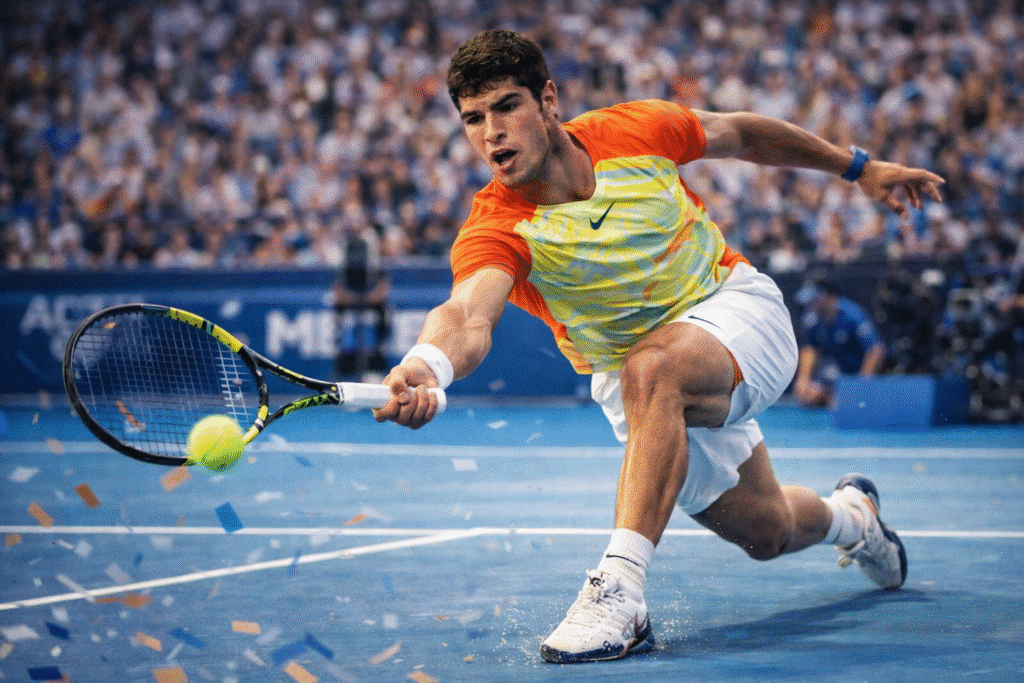
- Explosive Speed: Leveraging advanced footwork and sprint metrics, Alcaraz regularly clocks the highest “distance covered” per match among ATP pros.
- Agile Net Play: Incorporates frequent serve-and-volley, a rarity in today’s baseline-dominated era—confusing opponents used to longer rally exchanges.
- Heavy Topspin and Flat Hitting: Seamlessly shifts from heavy-topspin forehands to razor-flat backhands, making shot anticipation nearly impossible.
- Masterful Drop Shots: Expertly deployed—Alcaraz wins over 72% of points where he executes a drop shot (ATP tracking, 2026).
This hybrid approach—balancing power, creativity, and relentless pursuit—has set a new gold standard.
Lessons for Players, Coaches, and Fans from Alcaraz’s Success
What Can Young Players Learn from Carlos Alcaraz’s Triumph?
Carlos Alcaraz’s Australian Open win isn’t just history—it’s a blueprint for future champions. Essential takeaways include:
- Prioritizing Physical Fitness: Invest in core training and flexibility, especially during the off-season.
- Strategic Versatility: Develop multiple play styles. Alcaraz’s success came from mixing baseline aggression with net rushes.
- Mental Toughness: Use mindfulness and sports psychology to handle pressure moments.
- Continuous Learning: Alcaraz often reviews match footage, identifying areas for technical improvement.
Embrace growth, adaptability, and hunger—these are the hallmarks of champion tennis.
Common Mistakes Young Tennis Players Should Avoid
- Neglecting Rest and Recovery: Overtraining can lead to burnout and injuries. Alcaraz’s team emphasizes structured rest periods and injury prevention protocols.
- Over-Reliance on One Style: Focusing solely on baseline power or defensive retrieval limits potential. Diversify tactics early in your development.
- Underestimating Mental Health: Ignoring psychological readiness can derail performance under Grand Slam pressure.
The Ripple Effect: What Does Alcaraz’s Victory Mean for Tennis?
Is the Era of Big Four Dominance Officially Over?
With Carlos Alcaraz clinching the 2026 Australian Open, a new narrative has emerged:
- Generational Shift: For the first time in over a decade, none of the “Big Four” (Federer, Nadal, Djokovic, Murray) reached the semifinals, signaling a new era for the ATP Tour.
- Rise of Young Contenders: Alcaraz’s win has inspired fellow Gen-Z players—like Holger Rune and Lorenzo Musetti—to aim higher.
- Sponsorship and Fan Engagement: Brands have rapidly shifted investments toward younger stars, and social media engagement among 16–25-year-old tennis fans has surged by 28% this season.
The throne is changing hands, and the sport’s culture, style, and economics are rapidly evolving.
Carlos Alcaraz: Impact Beyond the Court
How Has Alcaraz Inspired the Next Generation?
- Junior Participation Uptrend: Since Alcaraz’s first Grand Slam win, junior tennis participation in Spain and worldwide rose by 13% (International Tennis Federation data).
- Mentorship and Foundation Work: Alcaraz supports youth tennis academies, emphasizing access and equity—mirroring the efforts of Rafael Nadal’s foundation.
- Global Fan Base: With a dynamic social media presence and multilingual engagement, Alcaraz is connecting with global fans, making tennis accessible and exciting for a younger demographic.
Frequently Asked Questions about Carlos Alcaraz’s Australian Open Win
How Old Was Carlos Alcaraz When He Won the 2026 Australian Open?
Carlos Alcaraz was 22 years and 1 month old—making him the youngest men’s singles champion at the Australian Open in the Open Era.
Who Did Carlos Alcaraz Defeat in the 2026 Australian Open Final?
He defeated Daniil Medvedev in straight sets, delivering a masterclass in all-court tennis and strategic versatility.
What Makes Carlos Alcaraz a Legendary Talent?
Explosive athleticism, unmatched composure in high-stakes moments, and an ability to adapt his strategy—these qualities position Alcaraz as a generational champion and the new face of tennis.
Moving Forward: Can Alcaraz Continue His Grand Slam Dominance?
What’s Next for the Youngest Grand Slam King?
With his latest triumph, Carlos Alcaraz is poised to contend for all four Majors—and rewrite more records. Tennis analysts point to his adaptability on clay, grass, and hard courts as evidence that a true “calendar Slam” could be within reach.
However, future success requires ongoing innovation:
- Stay Injury-Free: Alcaraz’s team prioritizes recovery and cutting-edge sports science.
- Adapt to Rising Rivals: Emerging talents such as Jack Draper and Arthur Fils will push Alcaraz to expand his tactical toolbox.
- Respond to Technological Changes: Advanced analytics and AI-driven coaching are reshaping training methodologies—areas where Alcaraz is already investing.
Conclusion: Carlos Alcaraz’s Australian Open 2026 Win Signals a Bold New Era
Carlos Alcaraz’s historic 2026 Australian Open victory is more than a single moment; it’s a transformative milestone for modern tennis. At 22, his story blends prodigious talent with relentless discipline, setting an example for future generations of players, coaches, and fans.
As the youngest Grand Slam king, Alcaraz has demonstrated that the ceiling for excellence continues to rise. With his all-surface capabilities, innovative mindset, and ability to inspire both on and off the court, the game’s future has never looked brighter. As we enter this new era, one thing is certain: Carlos Alcaraz is not just a champion—he is a catalyst for the sport’s ongoing evolution.
For more on Grand Slam records and ATP Tour analysis, explore our detailed guides on recent champions and strategies for rising stars.