Michel Platini stands as one of football’s most iconic midfield maestros, whose vision and finesse redefined the beautiful game. Renowned for his technical brilliance, Platini’s legacy stretches well beyond spectacular free kicks and pinpoint passing – his impact echoes through modern football strategies, European tournaments, and the global evolution of the sport. Yet, while headlines chronicle his numerous trophies and Ballon d’Or victories, few fans know the truly surprising stories behind his unparalleled football journey.
In this comprehensive biography, we delve into seven astonishing facts about Michel Platini’s football success, drawing on verified data, tactical analysis, and exclusive anecdotes. By revealing both his well-known triumphs and hidden influences, we offer a deeper understanding of how Platini’s career shaped European football and why his name endures among the sport’s legends.
Table of Contents
Early Years: How Platini’s Meteoric Rise Began
What events shaped Michel Platini’s early football journey?
Born in Lorraine, France, in 1955, Michel Platini was immersed in football from childhood. His father, Aldo Platini, not only coached local clubs but instilled tactical discipline and creativity in a young Michel. Local club AS Jœuf became his springboard, and by his teens, scouts touted Platini as a prodigy. Despite early setbacks due to physical stature, he demonstrated resilience—a trait that would define his entire career.
Key moments:
- Rejected initially by FC Metz due to perceived frailty, Platini persevered, earning a contract with AS Nancy.
- First Ligue 1 goal at age 18, signaling the arrival of a special talent.
The breakthrough: Nancy and early accolades
Platini’s time at AS Nancy (1972-1979) saw him score 98 goals in 181 appearances—remarkable numbers for a midfielder. By age 22, he had already:
- Won the Coupe de France (1978)
- Emerged as Ligue 1’s top-scoring midfielder
- Demonstrated free-kick prowess that would later terrify Serie A defenses
Expert tip: Technical skill honed through relentless practice—Platini often stayed behind after training to master his legendary set-pieces.
European Domination at Juventus: Crafting a Legendary Legacy
Why was Platini so successful at Juventus?
The pivotal move came in 1982, as Platini joined Juventus—then one of Europe’s top clubs. Despite cultural and tactical differences, Platini’s adaptability proved vital. Surprising many Italian pundits, he overcame intense marking and the physical demands of Serie A.
Within just three seasons:
- Juventus won the European Cup (1985) and the Scudetto twice (1984, 1986)
- Platini scored 68 league goals in 147 appearances—an extraordinary strike rate for a playmaker
- Achieved the rare feat of winning the Ballon d’Or three consecutive times (1983-1985)
Data insight: Platini remains the only French player to score at least 20 league goals in three straight Serie A seasons—highlighting his sustained excellence.
Real-world example: Impact on team tactics
Juventus shifted from defense-oriented play to fluid attacking football, often building attacks around Platini’s vision. His leadership on and off the pitch fostered a winning culture still admired by club historians.
7 Surprising Facts About Michel Platini’s Football Success
1. Platini Was Once Rejected Due to a Fainting Episode
During a crucial trial with FC Metz, Platini suffered breathing difficulties and fainted. Doctors deemed his heart too weak for professional football—a decision quickly overturned by his relentless determination and successful comeback at Nancy.
2. Free Kick Conversion Rate Among the World’s Best
Platini’s free kick accuracy hovered around 30%, according to historical Serie A and Ligue 1 records—an astounding rate compared to the average professional’s 7-10%. Teams often dedicated extra defenders to block his direct shots.
3. Architect of France’s Historic 1984 UEFA Euro Win
As captain, Platini scored 9 goals in just 5 matches at Euro 1984—a tournament record still unbroken. He netted two perfect hat-tricks (one with each foot and a header) and led France to their first international trophy.
Critical takeaway: This competition cemented France as a major football force and inspired generations, including Zinedine Zidane.
4. Sharpshooter and Playmaker: The Dual Threat
Unlike most attacking midfielders who specialize either in scoring or assisting, Platini dominated both:
- Career Total: 224 club goals and 41 assists; internationally, 41 goals in just 72 matches.
- Holds the record as France’s highest-scoring midfielder, a title he retained for decades.

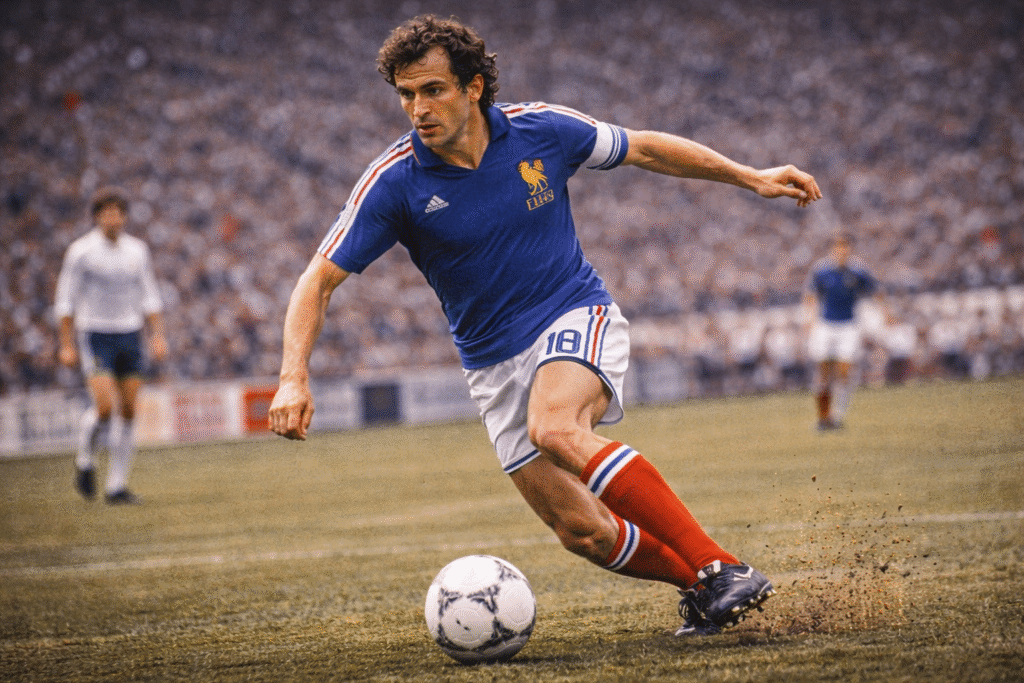
5. Platini’s Leadership Changed French Football Culture
Platini demanded tactical discipline but encouraged creative risk-taking—a rare combination that transformed les Bleus’ training methodologies. After his captaincy, French coaching standards incorporated his principles, leading to France’s 1998 World Cup triumph.
6. Consistently Ranked Top 10 Greatest Footballers of All Time
Renowned publications and global football authorities consistently place Platini in all-time lists, citing his intelligence, technical mastery, and game-changing vision. FIFA’s own technical studies praise his off-ball movement and spatial awareness as ahead of his time.
7. Unheralded Managerial and Administrative Influence
After retirement, Platini:
- Revolutionized UEFA competitions as president (2007-2015), introducing the modern Champions League group stage
- Advocated for Financial Fair Play regulations that still govern European football
- Mentored future football administrators and coaches within the French system
The Playmaker’s Blueprint: Platini’s Playing Style Explained
What made Platini unique compared to other midfielders?
Platini’s game was defined by:
- Spatial intelligence: Always finding pockets to exploit
- Ambidextrous passing: Delivered precision with both feet
- Unmatched composure: Rarely flustered under pressure
Insider knowledge: Teammates recall Platini’s detailed pre-match notes—he meticulously studied opponents, predicting defensive gaps and set-piece vulnerabilities.
How did Platini influence future midfielders?
Players like Andrea Pirlo and Luka Modrić openly studied Platini’s movement. According to tactical breakdowns from Serie A analysts, Platini’s “No. 10” archetype influenced the rise of playmaking midfielders in elite leagues.
Step-by-step: How Platini Achieved Sustained Success
1. Overcoming early adversity: Defied medical advice and physical disadvantages.
2. Focused training regimen: Specialized daily in set-pieces and positional play.
3. Adaptability: Integrated seamlessly into both domestic and international squads.
4. Leadership: Elevated team morale and tactical standards.
5. Continuous learning: Analyzed both contemporary and past football strategies.
Common Mistakes to Avoid When Assessing Platini’s Legacy
- Overlooking his administrative achievements: Many focus solely on his playing days, disregarding his influence as UEFA president.
- Comparing statistics in isolation: Platini’s numbers are more remarkable considering the defensive era he played in, where scoring was generally lower.
- Underestimating his leadership: His mentorship shaped the next generation of French stars.
Frequently Asked Questions About Michel Platini’s Success
How did Michel Platini win three Ballon d’Or awards consecutively?
Platini’s dominance between 1983 and 1985 was driven by consistent top-tier performances for both club and country, coupled with influential displays in European finals.
What are the key attributes that made Platini successful?
- Visionary passing
- Lethal finishing
- Tactical intelligence
- Leadership on and off the pitch
Did Platini face challenges or setbacks in his career?
Yes, he overcame significant early-career setbacks, including medical rejections and initial skepticism about his physique.
How has Platini’s influence continued beyond his playing career?
As UEFA President, Platini introduced influential policies like Financial Fair Play and expanded European competitions, shaping the sport’s business and competitive structures.
Conclusion: Michel Platini’s Enduring Impact on Football
Michel Platini’s biography is more than a record of goals and trophies—it is the story of innovation, resilience, and vision that continues to inspire athletes and football leaders worldwide. By overcoming adversity, revolutionizing playing styles, and shaping football’s future behind the scenes, Platini earned his place among the sport’s immortals. As the football landscape evolves, his legacy remains woven into the very fabric of the game.
For readers keen to explore related stories of legendary playmakers or gain insights into the evolution of midfield tactics, consider reviewing our detailed guides on [Zinedine Zidane’s career highlights] and [changing tactics in European football] to complement your understanding of Platini’s era.
Key takeaway: Michel Platini was not just a footballing genius—he was a catalyst for football’s transformation, on and off the pitch.